
Perhaps those of you reading this page are interested in working with breath, feeling, and movement but you want to know more about the science that validates these practices. So read on!
In 2023, I first realized – thanks to a podcast – that the practice of conscious, connected, breath could be a way to bring the sympathetic and parasympathetic branches of the autonomic nervous system (ANS) into balance. This is due to the connections between the diaphragm and the ANS.
The ANS plays a primary role in the stress response (flight/fight/freeze). As well as anxiety. It regulates key body functions, including the heart rate, the tone of the muscles lining the blood vessels, digestion, and other systems that keep us functioning. We can’t direct it consciously. Except for breathing. Most of the time we are not aware of our respiration…but when we want to, we can control it. Such as when we hold our breath or take an extra large deep breath.
And most of us know expressions such as: “it took my breath away”, or “I held my breath to see what would happen”. Or “I was frozen in place”, “I felt numb”. These phrases speak to the fact that there is an intuitive awareness of the relationship of breath and body sensation/movement are to our emotional states. Although this isn’t covered in medical textbooks.
When I put this information together, I was convinced that the practice of conscious, connected breath could help me feel more connected, balanced, and at ease in life. I went and received my first session of Transformational Breath. Although I had just completed the 8 week MBSR course to learn to meditate, the feeling of wholes and ease after my first session of Transformational Breath convinced me as a medical doctor that continuing with Transformational Breath could help me with my rising blood pressure. It was still poorly controlled even after trying several drugs. But after one year of working with Transformational Breath, it had come back to the normal range.
A bit more detail on why I think that the full, conscious, connected breath which is the basis of Transformational Breath works its wonders.
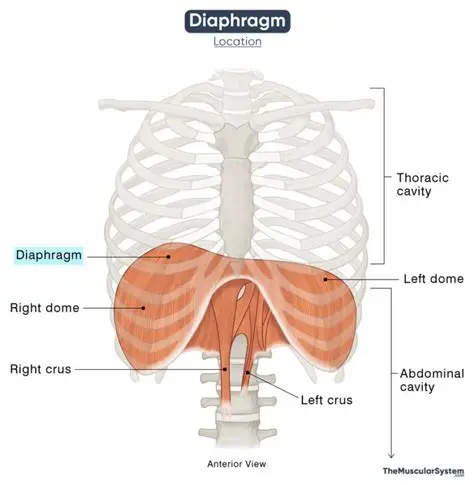
The diaphragm is a large dome-shaped muscle sitting just under the rib cage see below.
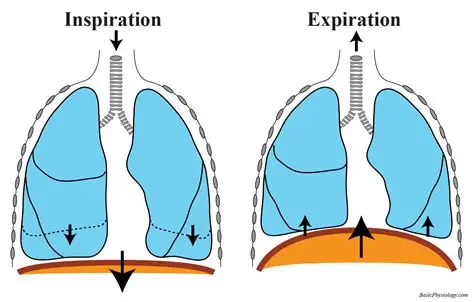
During inspiration (an in-breath), the diaphragm flattens, which allows the lungs to expand and for air to enter the body. With a full abdominal breath, the internal organs beneath the diaphragm, including the digestive tract, are gently massaged.
During expiration (an out-breath), the diaphragm goes back to its dome-shaped form as shown above.
Two sets of nerves play an important role: the phrenic nerve (sympathetic) for activating the diaphragm, and the vagus nerve (parasympathetic) for relaxation.
Both of these both SEND and RECEIVE information, meaning that they are affected by the movement of the diaphragm as well as making it contract and relax.
When I realized that, it made sense to me that it could be possible to work consciously with the breath and thus affect the autonomic nervous system, which in turn could help regulate my blood pressure.
With regards to these- both fall into the category of somatic practices – my inspiration started at the beginning of my career. As a primary care doctor, I had many people come into my office complaining of symptoms such as fatigue, or vague digestive problems, or various aches and pains that did not “fit” any standard medical diagnosis. I would naturally order a few lab tests to make sure there was not something serious going on. But I could usually provide was just reassurance along with a few basic recommendations around diet and exercise.
Fast forwarding to the start of my journey with Transformational Breath, as I felt more energy circulating, I wanted to explore movement and dance, and came across Tamalpa Life Art Process (TLAP). See: [page]
TLAP is a member of the International Somatic Education and Therapy Association which represents the profession of Somatic movement education and therapy. It has dozens of members, who teach and practice a large diversity of somatic practices(https://ismeta.org/organizations). What these all have in common is a focus on the body both as an “objective physical process and as a subjective process of lived consciousness”. They have also compiled their own research database, which is freely accessible.
And as I read and learned more about the link between mind and body, I came across Peter Levine’s book “Waking the Tiger: Healing Trauma”, which was a best seller. I discovered yet another way of working with the body – through the exploration of body experience through interoception and proprioception. And I started training in Somatic Experiencing (SE) in early 2026.
With regards to the science, Somatic Experiencing International has been compiling its own research database.
This is not exhaustive, but could be a good place to start your own inquiry.